The 3 Essential Knife Skills Every Home Cook Needs to Master by 2026 for Faster Meal Prep (PRACTICAL SOLUTIONS)
In the bustling rhythm of modern life, where every minute counts, the kitchen often becomes a battleground against time. For many home cooks, the most time-consuming and sometimes intimidating part of meal preparation isn’t the cooking itself, but the prep work: the endless chopping, slicing, and dicing of ingredients. Imagine a world where your vegetables are prepped in half the time, your cuts are consistently uniform, and your kitchen feels less like a chore and more like a creative sanctuary. This isn’t a culinary fantasy; it’s an achievable reality when you master a few essential knife skills.
Anúncios
By 2026, the landscape of home cooking continues to evolve, with an increasing emphasis on efficiency, health, and gourmet quality achievable in your own kitchen. To keep pace and truly elevate your culinary game, honing your knife skills isn’t just an advantage; it’s a necessity. This comprehensive guide will walk you through the three foundational knife skills that will revolutionize your meal prep, boost your confidence, and transform your cooking experience from daunting to delightful. We’ll delve into practical solutions, detailed techniques, and common pitfalls to avoid, ensuring that by the end of this article, you’ll be well-equipped to practice and perfect these indispensable abilities.
Why are essential knife skills so critical? Beyond the obvious time-saving aspect, precise knife work ensures even cooking, enhances the aesthetic appeal of your dishes, and most importantly, significantly improves kitchen safety. A dull knife and clumsy technique are far more dangerous than a sharp knife wielded with confidence and skill. This article is your roadmap to becoming a more efficient, safer, and ultimately happier home cook. Let’s sharpen our focus and dive into the world of superior knife mastery.
Anúncios
The Foundation: Understanding Your Tools and Stance
Before we even begin to talk about specific cuts, it’s paramount to understand the tools of the trade and how to position yourself for success. A craftsman is only as good as his tools, and a cook is only as good as their knife. Investing in a good quality chef’s knife (typically 8-10 inches) is the first step. Look for one that feels balanced in your hand, with a comfortable grip. Stainless steel is common, but high-carbon stainless steel offers a better edge retention. Keep it sharp! A dull knife requires more force, increasing the risk of slips and injury. Regular honing with a steel and occasional sharpening are non-negotiable.
Proper Grip: The Key to Control and Precision
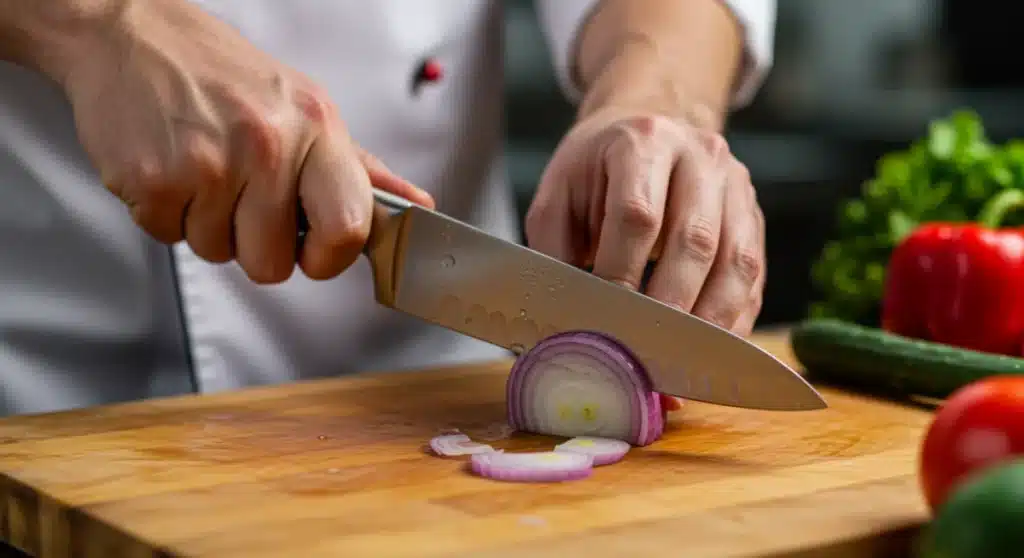
Forget the ‘handle grip’ you might instinctively use for a butter knife. For a chef’s knife, the ‘pinch grip’ is king. This involves pinching the heel of the blade between your thumb and forefinger, with the rest of your fingers wrapped around the handle. This grip provides maximum control over the blade, allowing for precise movements and reducing strain on your wrist. Practice holding your knife this way until it feels natural.
The Non-Dominant Hand: Your Safety Shield
Your non-dominant hand plays an equally crucial role, primarily as a guide and a protector. The ‘claw grip’ is fundamental here. Curl your fingertips inwards, tucking them under your knuckles, forming a protective barrier against the blade. Your knuckles should guide the knife, allowing it to glide safely along them as you cut. This technique is non-negotiable for safety and consistency.
Stance and Cutting Board: Stability is Paramount
Your body posture and the stability of your cutting surface are often overlooked but are integral to efficient and safe knife work. Stand comfortably with your feet shoulder-width apart, slightly staggered, facing the cutting board. Ensure your cutting board is stable and doesn’t slip. A damp paper towel or a non-slip mat underneath your board will prevent it from moving, significantly reducing the risk of accidents. A stable cutting surface means you can focus entirely on your knife and ingredients, a core aspect of mastering essential knife skills.
Essential Knife Skill 1: The Art of the Efficient Chop (Rough Chopping)
The most basic yet frequently used knife skill is chopping. While it might seem straightforward, there’s a significant difference between haphazard hacking and an efficient, controlled chop. This skill is about breaking down ingredients into smaller, manageable pieces, often without the need for perfect uniformity, making it ideal for soups, stews, and sauces where ingredients will be cooked down.
Technique Breakdown: The Rocking Motion
- Preparation: Stabilize your ingredient. For round items like onions or bell peppers, slice them in half or quarter them to create a flat, stable surface.
- The Claw Grip: With your non-dominant hand, hold the ingredient firmly using the claw grip. Your knuckles should be pressed against the side of the knife blade, guiding it.
- The Rocking Motion: Position the tip of your knife on the cutting board, keeping it stationary. Lift the heel of the knife and bring it down through the ingredient, pushing forward slightly as you cut. This creates a natural rocking motion.
- Repetition: Continue this rocking motion, moving your non-dominant hand backward along the ingredient as you chop, always maintaining the claw grip. The goal is to create roughly uniform pieces.
Practical Solutions for Chopping:
- Onions: Cut an onion in half lengthwise (root to tip). Place cut-side down. Make horizontal cuts from the root to near the top, then vertical cuts, and finally chop across. This technique is incredibly efficient for producing small, consistent pieces.
- Herbs: Gather a bunch of herbs tightly. Use the rocking motion to finely chop them. For extra fine results, you can rock over them multiple times.
- Garlic: Smash garlic cloves with the flat side of your knife to easily remove the skin, then use a fine rocking motion to mince.
Mastering the efficient chop is your gateway to faster initial prep work. It reduces cooking times by ensuring ingredients cook evenly and integrates flavors more uniformly into your dishes. This foundational skill is truly one of the most essential knife skills for any aspiring home chef.
Essential Knife Skill 2: The Precision of Dicing (Uniform Cubes)
Dicing takes chopping to the next level, demanding greater precision and consistency. The goal of dicing is to create uniformly sized cubes, which is crucial for dishes where even cooking and presentation are key, such as stir-fries, salads, and vegetable medleys. Achieving perfect dice requires patience and practice, but the results are incredibly rewarding.
Technique Breakdown: From Slices to Sticks to Cubes
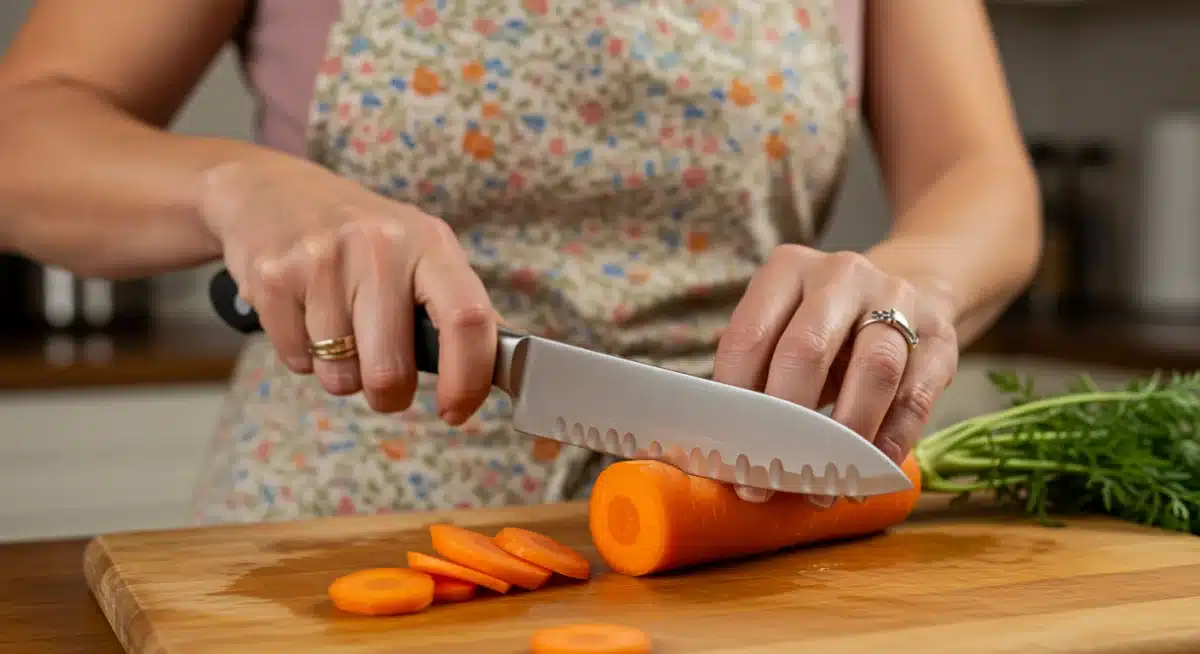
- Square Off: Start by squaring off your ingredient. For example, with a carrot, peel it and trim the ends. Then, cut it into manageable lengths (e.g., 2-3 inches).
- Slicing: Using the pinch grip and claw grip, make even slices along the length of the squared-off piece. Aim for the desired thickness of your dice (e.g., 1/4 inch for a small dice, 1/2 inch for a medium dice).
- Julienning (Sticks): Stack your slices neatly. Then, cut across the stack to create uniform sticks (julienne). Again, the thickness of these sticks should match your desired dice size.
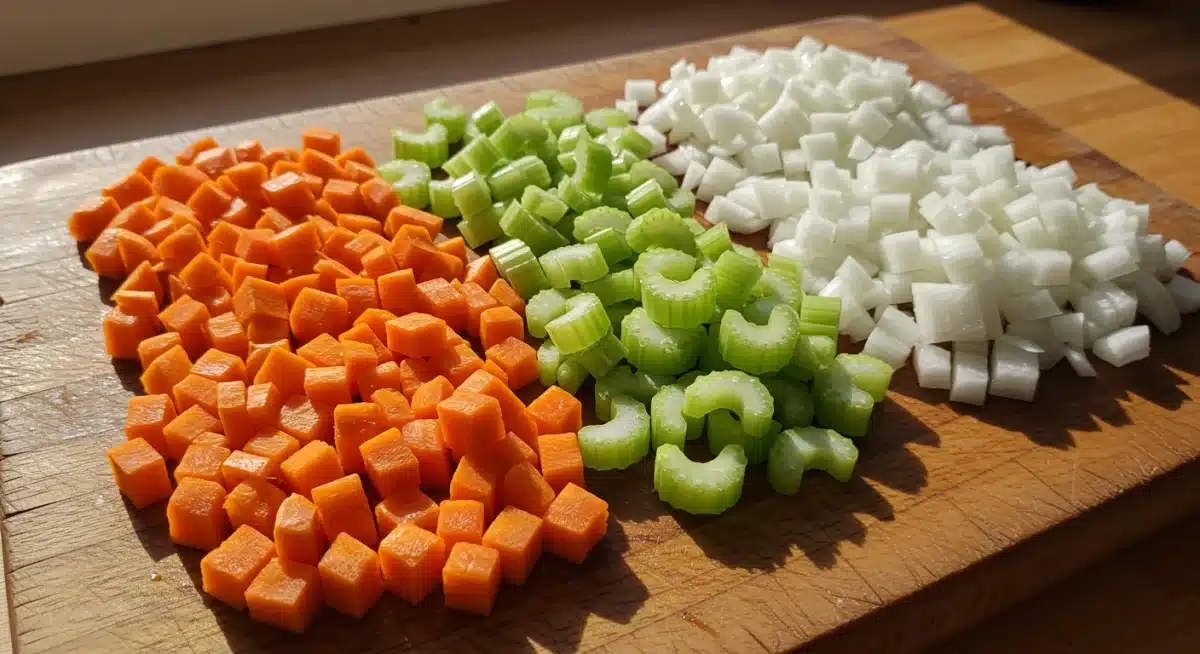
- Dicing (Cubes): Gather your julienned sticks together. Now, cut across the sticks, creating perfectly uniform cubes. Maintain your claw grip and a steady, controlled downward motion.
Practical Solutions for Dicing:
- Potatoes/Sweet Potatoes: After peeling, cut into planks, then sticks, then dice. Uniformity here is vital for even cooking, especially when roasting or frying.
- Bell Peppers: Core and deseed the pepper. Lay it flat, skin-side down. Make even slices, then turn and cut into sticks, and finally dice.
- Celery: Trim the ends and remove any tough strings. Slice lengthwise if the stalks are very wide, then cut crosswise into uniform pieces.
The beauty of dicing lies in its consistency. When all pieces are the same size, they cook at the same rate, preventing some ingredients from being overcooked while others remain raw. This precision elevates both the taste and presentation of your dishes, making it an indispensable part of your repertoire of essential knife skills.
Essential Knife Skill 3: The Finesse of Mincing (Finely Chopped)
Mincing is the art of chopping ingredients into extremely small, almost paste-like pieces. This technique is primarily used for aromatics like garlic, ginger, and shallots, where you want their flavor to be fully integrated into a dish without large, noticeable chunks. Mincing extracts maximum flavor and aroma, making it a critical skill for building complex flavor profiles in sauces, marinades, and dressings.
Technique Breakdown: The Refined Rocking Motion
- Initial Chop: Start by roughly chopping your ingredient using the rocking motion we discussed earlier. The smaller you get it initially, the easier the mincing process will be.
- Gather and Rock: Use the flat side of your knife blade to gather the chopped ingredients into a small pile.
- The Mincing Motion: Place the tip of your knife on the cutting board, keeping it stationary. Place your non-dominant hand on the spine (the dull top edge) of the knife for added pressure and control. Rock the knife back and forth over the pile of ingredients, pivoting on the tip.
- Scoop and Repeat: Periodically lift the heel of the knife and scoop the ingredients back into a pile, rotating the pile as you do so. This ensures all pieces get minced evenly. Continue rocking and scooping until the desired fineness is achieved.
Practical Solutions for Mincing:
- Garlic: After peeling, smash the cloves with the flat side of your knife. This breaks down the cell walls and makes mincing much easier. Then proceed with the rocking and scooping method.
- Ginger: Peel the ginger first (a spoon works wonders for this!). Slice it thinly, then julienne, then proceed to mince using the rocking motion.
- Shallots: Halve lengthwise, peel, then make very fine horizontal and vertical cuts before mincing across, similar to the onion technique but aiming for much smaller pieces.
Mincing is where true finesse comes into play. It requires a delicate touch combined with consistent motion. The result is a burst of flavor in every bite, making your cooking more aromatic and delicious. Mastering this skill truly completes your foundation of essential knife skills.
Beyond the Big Three: Advanced Tips for Knife Mastery
While the three skills above form the bedrock of efficient meal prep, here are some additional tips and considerations to further refine your knife mastery:
Keep Your Knives Sharp!
We cannot stress this enough. A sharp knife is not only more efficient but also significantly safer. Invest in a good honing steel and use it before almost every cooking session. Learn how to properly use a sharpening stone or consider professional sharpening a few times a year. A sharp knife glides through food; a dull knife tears and slips.
Practice, Practice, Practice
Like any skill, knife work improves with repetition. Don’t get discouraged if your first attempts aren’t perfect. Start with softer vegetables like zucchini or bell peppers before moving on to harder ones. Dedicate a few minutes each day to practicing your cuts, even if it’s just chopping an extra onion.
Utilize Different Knives
While the chef’s knife is your workhorse, don’t forget about other specialized knives. A paring knife is excellent for smaller, more intricate tasks like peeling or coring fruits. A serrated knife is indispensable for slicing bread or tomatoes without crushing them. Understanding when to use which knife enhances your efficiency and results.
Maintain Your Cutting Board
A clean, stable cutting board is a happy cutting board. Keep it clean to prevent cross-contamination. Replace it when it becomes too scarred, as deep grooves can harbor bacteria and make it harder to achieve clean cuts. Wood or bamboo boards are often preferred for their knife-friendly surfaces, but durable plastic boards are also good options.
Safety First, Always
Always cut away from your body. Keep your fingers tucked in with the claw grip. Pay attention to what you’re doing; distractions in the kitchen can lead to accidents. If you feel tired or rushed, slow down. Your safety is paramount.
The Transformative Power of Mastering Essential Knife Skills by 2026
Imagine yourself in 2026, effortlessly gliding through meal prep. Onions are uniformly diced in mere seconds, garlic is minced to perfection, and vegetables for your stir-fry are all the same size, ensuring they cook beautifully and simultaneously. This isn’t just about speed; it’s about confidence, precision, and a deeper enjoyment of the cooking process.
Mastering these essential knife skills by 2026 will not only save you precious time during your daily meal prep but also elevate the quality of your home-cooked meals. Your dishes will look more professional, cook more evenly, and taste better because of the consistent size and texture of your ingredients. Furthermore, you’ll find a newfound sense of joy and control in the kitchen, turning a once-dreaded chore into a meditative and creative activity.
The Ripple Effect: Beyond the Cutting Board
The benefits of improved knife skills extend beyond the cutting board. With faster prep, you’ll have more time to experiment with new recipes, explore different cuisines, and spend quality time with loved ones. You’ll also likely reduce food waste, as precise cutting often means using more of the ingredient and less going into the compost bin. This efficiency translates to a more sustainable and enjoyable cooking lifestyle.
Think of knife skills as the fundamental language of the kitchen. Once you become fluent, you can express yourself more freely and creatively through your cooking. It’s an investment in yourself as a home cook that pays dividends in every meal you prepare.
Conclusion: Your Journey to Knife Mastery Begins Now
The journey to mastering essential knife skills is a continuous one, but with a focused approach on the efficient chop, the precision dice, and the finesse of mincing, you will build an incredibly strong foundation. By committing to practice and understanding the nuances of your tools and techniques, you will undoubtedly transform your kitchen experience by 2026.
Don’t wait. Grab your best chef’s knife, secure your cutting board, and start practicing these techniques today. Watch videos, read guides, and most importantly, get hands-on experience. The path to faster meal prep, safer cooking, and more delicious results is literally at your fingertips. Embrace the challenge, enjoy the process, and become the confident, skilled home cook you aspire to be. Your future self, enjoying perfectly prepped meals with ease, will thank you.
Remember, every great chef started somewhere, and their secret often lies in the mastery of the basics. Make these three essential knife skills your priority, and unlock a world of culinary possibilities in your own kitchen.